
Google’s AI SEO: Is Traditional SEO Really Dead? (And What To Do Instead)
 Anjana Bhaskar July 2, 2025 5 min read
Technically, Google didn’t kill SEO. It automated SEO and integrated it with intent.
Everything that once made SEO a competitive advantage (content optimization, keyword research, technical SEO, clustering, topic expansion, even draft creation) AI can now do in seconds.
What’s more – AI tools aren’t just automating SEO tasks they’re continuously learning, reducing the need for human intuition in areas like content creation and ranking logic. As a result, roles centered on traditional SEO execution are becoming less relevant, with AI delivering comparable results in a fraction of the time.
So, what’s left?
Authority. Originality. Voice. Trust. Optimizing for AI discovery is the new norm.
In 2025, winning at SEO isn’t about playing the algorithm. It’s about becoming the source that AI wants to quote. And that changes everything.
Let’s explore what’s changing and what your digital marketing focus areas need to be in 2025.
The SEO machine is fully built. You’re no longer the builder.
Here’s what most marketers haven’t fully grasped yet: Google’s AI SERP doesn’t just rank your content. It uses your content to generate answers that users never have to click through.
The new search journey looks like this:
A user types a query
↓
Google AI engine interprets the intent of the query
↓
Google’s AI pulls together a summary from multiple sources (NOT just from keyworded content)
↓
The user gets an answer instantly
↓
Your brand gets zero engagement unless you’re the authority
This isn’t a tweak. It’s a complete compression of the funnel. Long-tail traffic is vanishing. Click-throughs are declining. Rankings mean less than ever, unless you’re the source of truth.
AI and SEO: What’s really changed?
Let’s break it down.
1. Search results are now AI-generated previews
Users get what they need in the overview panel. If your content isn’t authoritative or structured, it won’t be featured– and may never be seen.
2. AI handles what used to be your advantage
Clustering, entity mapping, topic modeling, NLP-based draft generation – all now standard in AI tools. If you're still writing keyword-optimized listicles with ChatGPT and calling it strategy, you’re late to the game.
3. Trust is now the only differentiator
When AI has access to every blog on the internet, it doesn’t choose the most optimized one. It chooses the most credible one. Real names. Real experience. Real sources.
The death of long-tail content as a strategy
Remember when you could drive traffic by targeting hundreds of low-volume, low-competition keywords? That model is collapsing.
Here’s why:
- AI Overviews answer long-tail queries instantly by analyzing the intent of the user
- Google no longer rewards duplication with minor variation
- Even niche topics require authority signals to rank
The new reality: writing for search doesn’t guarantee visibility. Writing with intent, depth, and clarity does.
If AI can write it, it’s probably not worth ranking
This is your new editorial standard.
If a tool can generate your blog post with minimal prompts, it probably lacks the insight needed to matter. And Google’s AI knows it.
You don’t need more content. You need more signal.
- Add first-hand data
- Feature expert commentary
- Say something new
- Take a stance
- Go deep with easy-to-read examples
This isn’t about producing articles. It’s about producing answers.
The new SEO stack: What still works
You still need structure. You still need strategy. But the rules have changed.
Here’s what still drives visibility in the AI SEO era:
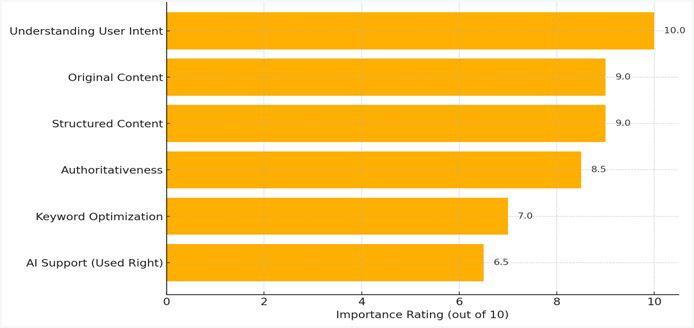
So where do you go from here?
SEO is no longer about showing up. It’s about being selected – by the algorithm and the user.
That means:
- Replacing blog calendars with editorial stances
- Auditing your content for actual insight, not just keywords
- Treating every page like it needs to prove its existence
- Producing trustable answers
- Investing in real authors, not faceless content farms
- Prioritizing relationships with readers, not rankings
AI impact on SEO: What’s changing, at a glance
Final thoughts: AI in Google SERP didn’t end content. It ended content without purpose.
The era of gaming Google is over. You’re not writing for search engines anymore. You’re writing through them– to people who trust them to filter the noise. Content is still the king and more so than ever before.
If you want to win that trust, you needto become the source. The reference. The original.
At Markiverse, we help brands do exactly that. Not just create content, but craft authority. Real, human-first, AI-credible content that earns its place.
👉Explore our content marketing services
Keep reading
More blog

2026: When AI Decides, Visibility Is Easy — Trust Is the Signal
If 2025 was the year brands recalibrated, 2026 is the year they sharpen their intent. Businesses are entering a new phase where clarity matters more than volume and where strategy wins over speed. Leaders are reassessing their digital marketing consulting services not just for advice, but for grounded guidance that supports measurable growth.
 Fatema AkolawalaRead
The 30-Day Growth Plan Mastering LinkedIn Marketing: What will Work – and What Won’t – in 2026
If your goal is reliable pipeline and predictable growth, treat LinkedIn marketing as a business channel, not a content hobby. In 2026 the LinkedIn algorithm 2026 rewards demonstrable outcomes, topical authority and meaningful engagement. That makes old tactics like blanket posting and viral-chasing far less effective. Below is a practical playbook you can adopt quickly, including organic content, paid tactics and campaign management tips that actually move revenue.
Anjana BhaskarRead 
From Voice Search to Generative AI – The Future Of SEO And Conversational Search
The future of SEO is being shaped by two related trends: voice interfaces and generative AI. Voice search optimization focuses on how users ask questions and how devices return spoken answers. Generative AI changes how answers are produced and summarized. Together they influence SEO evolution, but each requires a different set of priorities and technical work.
Anjana BhaskarRead